
The Boston Marathon
The Marathon That Changed Everything
Whether you visit Boston in July, November, or January, you will see people running in the streets and parks of Boston. Running culture in Boston is huge. People do it for health, personal growth, and to socialize with friends or run clubs. A significant factor in attracting all these runners to the weather-challenged Boston area is the globally recognized Boston Marathon.
As winter ends, with its barrage of snow and freezing, windy weather, runners practice, train, and drill for the big day on April 20th each year. This is locally known as ‘Marathon Monday’ and Patriots’ Day. A single day filled with hundreds of thousands of runners, spectators, and volunteers who gather to witness the talented, driven athleticism of running 26.2 miles.
How did this marathon get started? What makes it so special? How do you qualify? In this article, we will explore the history, achievements, and challenges that have shaped this marathon and enabled it to endure for 129 years.
Every year on the 3rd Monday in April, Patriots Day is celebrated, and Boston Marathon Runners begin their 26.2-mile challenge. Traditionally held on April 20th, this event is internationally renowned. The race's April date goes back to its founding.
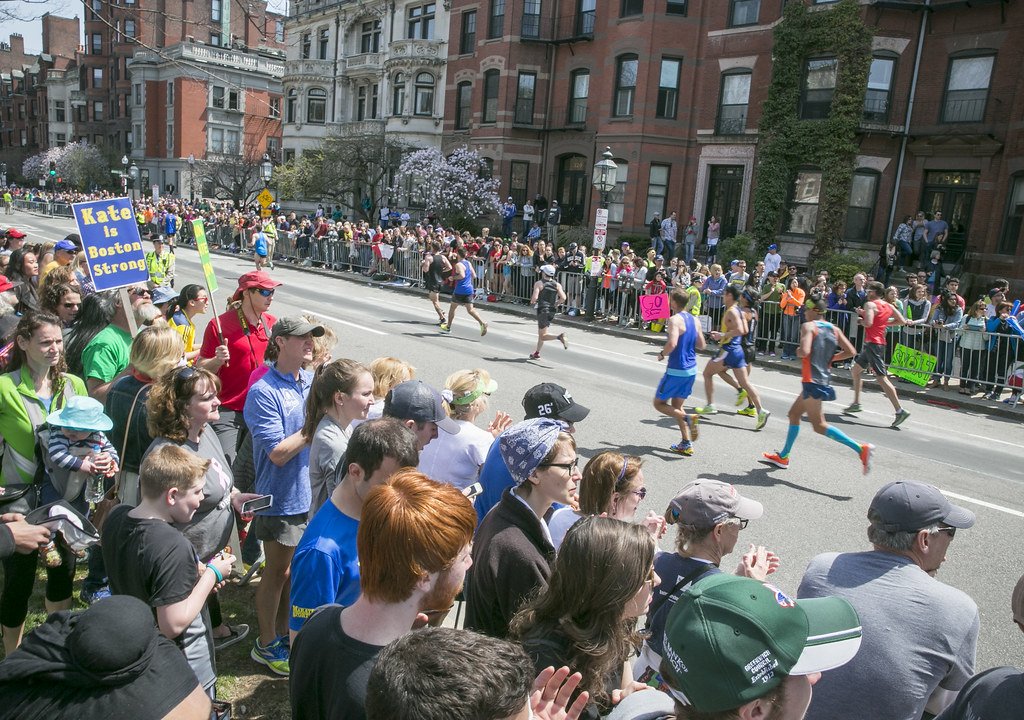
Boston Marathon spectators and runners
The Boston Marathon had its first race on April 19th, 1897. This race was conceived by John Graham, Manager of the Boston Athletics Association. The previous year, he traveled with a cohort of American Athletes (many from the Boston area) to the 1896 Olympic Games in Athens. There was an event called a ‘marathon’. Graham found this event to be powerful and wanted to replicate it in Boston. The following year marked the beginning of this historic race.
Graham decided that the date was deliberately placed on Patriots Day to celebrate the beginning of the American Revolution, which started April 19th, 1775, at the Battles of Lexington and Concord. With this race, Graham wanted the marathon to be the public face of this commemoration; a significant event that shaped the identity of Massachusetts and New England.
The first race in 1897 had some features that differed from how the race is operated now. For example, there were 15 racers. Many people did not know if this new concept of a ‘marathon’ was possible or even survivable. To ensure the runners' safety, each was assigned a bicyclist to ride with them, ready to help if they had to stop due to overexertion or injury. The race was 24.5 miles long (Ashland to Boston), runners were transported to the start by steam engine, and only 10 of the 15 racers finished.
This marked the beginning of a long-running tradition. For 129 years, the marathon has taken place. Surviving both World Wars and even the Great Depression, there have been only a few interruptions (1918 WWI relay, 2020 COVID delay), the race has run on or near April 19th since 1897.
Today, anyone can run in the Boston Marathon. There are significant requirements for running, but men, women, and non-binary individuals are eligible to apply. There is a wheelchair division, and paraplegic racers are welcome to run as well! Though anyone is eligible to participate, the Boston Marathon is really difficult to get into. There are a few ways to race.
You must run another marathon to qualify. Qualification standards are updated every few years and are very challenging to meet. If accepted with a qualifying time, you are “among the top 12% of marathoners”.
Alternatively, you can run to support a charity or a cause. This requires you to raise at least $5,000 to get into the race. This is an excellent way for amateur marathoners to participate and do good. Typically, the Boston Marathon raises $40 million every year!
Whether you run for yourself or for charity, it is a thrilling event to participate in.
Women and the Marathon
This inclusion has not always been the norm. Like anything that started long ago, evolving with the times has required necessary alterations to the rules and the race itself.
Due to the intensity of this athletic endeavor, women were not allowed to enter the race. In 1966, race Director Will Cloney claimed women were "physiologically incapable" of the distance. That very same year, Roberta ‘Bobbi’ Gibb, a female athlete, ran without a bib (sneaking into the start). Gibb finished in 3 hours, 21 minutes, and 40 seconds (3:21:40), faster than two-thirds of the men.
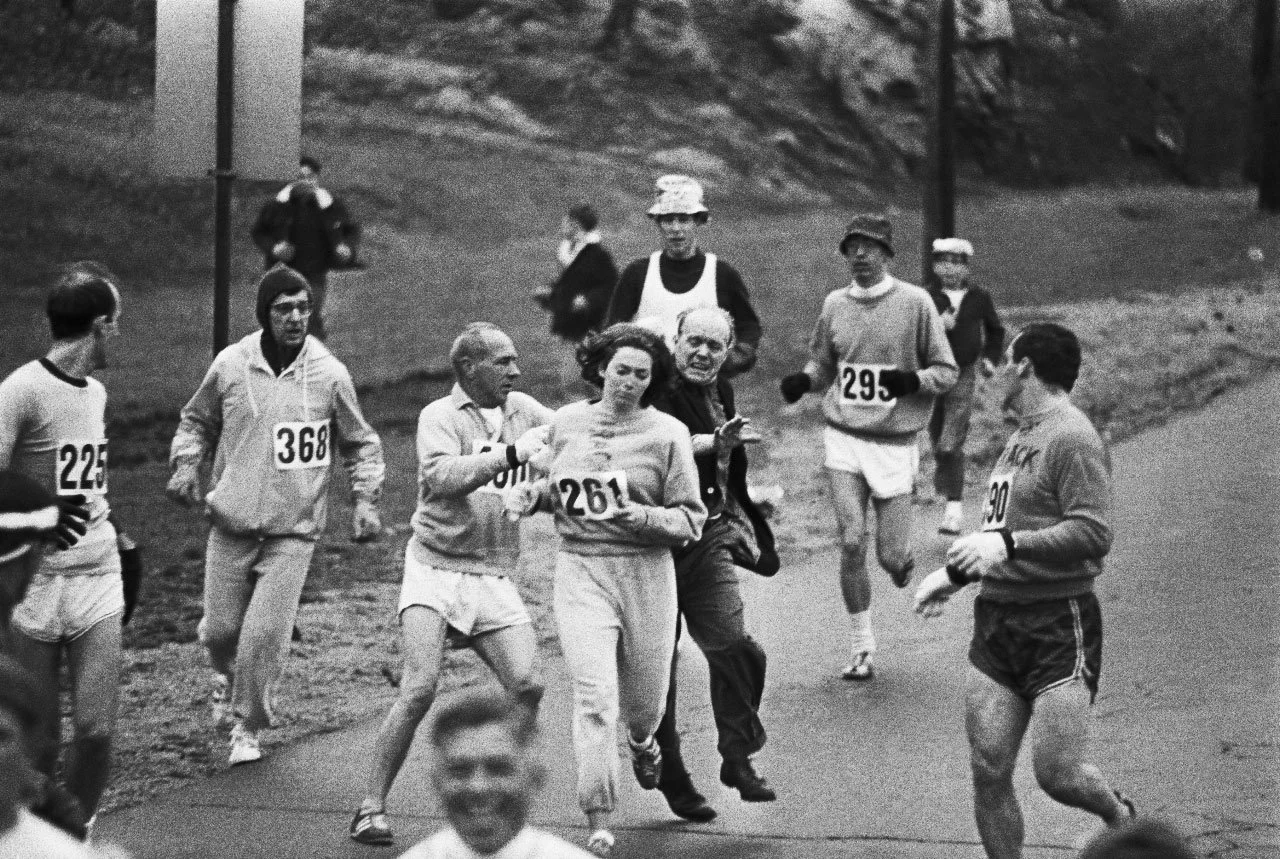
The following year, in 1967, Kathrine Switzer also challenged the concept of the female body as physically inferior, registering for the race and receiving a bib number. This started a controversy because she registered as "K.V. Switzer" to get a bib (#261) and did not clearly identify herself as a female on the race application. Realizing this, the race organizers tried unsuccessfully to remove her from the race.
Throughout the race, photos show the race administrators attempting to grab her and remove her while she was running! Official Jock Semple famously tried to physically remove her during the race. After she finished the marathon, the AAU (Amateur Athletic Union) changed its rules to ban women from competing against men.
However, this stance was short-lived, because only 4 years later, in 1971, the AAU finally permitted women to enter all of its sanctioned marathons, including Boston. In 1972, Nina Kuscsik became the first official women's champion of the Boston Marathon. That year, 8 women started the race, and all 8 finished. In recent years, women have made up approximately 45–47% of the field.
Participation & Equality
Another major development in inclusivity occurred in 1975 when Boston became the first major marathon to include a Wheelchair Division. Racer Bob Hall finished in 2:58:00, earning an official finisher certificate.
When Race Director Will Cloney told Bob Hall he’d get a certificate if he finished under three hours, he didn't realize he was opening the door for the most competitive para-athlete field in the world. Bob came through and set the course for future wheelchair athletes to participate.
Pioneering individuals like Bobbi Gibb, Kathrine Switzer, and Bob Hall challenged the set rules and showed that inclusion is better than exclusion. Today, the Boston Marathon is moving from a "test of legs" to a "test of human will."
In 2026, Boston will hold the 130th marathon! Throughout that time, the event has grown into the major spectacle it is today. Racing times have shifted as the course has been opened to inclusive division athletes and runners for charity. Since the explosion of interest in running in the 1960s and 70s, the B.A.A. introduced qualifying standards and implemented a 6-hour cutoff time. This 6-hour limit has been a hotly debated topic for the Boston Marathon, as it tries to balance elite athletic competition with a massive, inclusive community event.
In the 1980s, the Charity Runners were introduced to this event. Thousands of runners, who weren’t elite athletes, were raising millions of dollars. Some couldn’t keep pace, and B.A.A. had to loosen the ‘elite-only’ standard.
A significant change came after the 2013 Boston Marathon bombing. This new mentality, of “Finish What You Started” and Boston Strong response, shifted the race to emphasize resilience over speed. In 2014, the race administrators made great efforts to ensure that every runner who started could cross the finish line safely, regardless of their pace. This means that in each of the 8 cities that are part of this marathon course, rolling closures are used to limit the time that main traffic arteries are closed, and that their police, fire, and medical personnel are not out of commission for more than 6 hours.
In reviewing Boston Marathon times for the 30,000 runners from 2023 to 2025, the median has ranged from 3:33:39 to 3:43:26. Due to the strict qualification process, many runners have trained for this event and are performance-focused, either aiming to beat their time or simply complete the race. Charity runners do not need to meet a qualifying time, so their finishing times vary widely, typically from about 4:30:00 to 6:00:00.
Although BQ (Boston Qualifier) runners typically aim to match or beat their qualifying time, nearly 60% run slower than that mark on race day. The main reason is the course’s deceptively challenging profile: steep downhills early in the race that punish the quadriceps, followed by the demanding Newton hills in the later miles. On average, runners who miss their BQ target finish about 35 minutes slower than their qualifying standard.
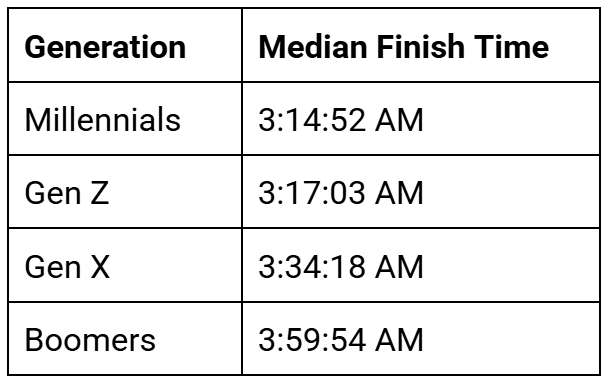
Average Times by Generation (2025 Data)
The most recent data from the 2025 race provides a clear snapshot of non-elite performance by age group:
Boston was one of the founding members of the World Marathon Majors (WMM). This is a series of marathons created to elevate marathon running into a championship-style circuit.
The WMM was formed in 2006 by the directors of the world’s five most prestigious marathons. Boston, London, Berlin, Chicago, and New York City marathons became a unified global circuit and goal of runners everywhere. Boston’s inaugural World Marathon Majors race began at the 110th Marathon on April 17th, 2006.
Since 2006, the number of cities participating in this international running collective has grown. In 2013, Tokyo joined as the sixth Major. Most recently, in 2025, Sydney officially joined the WMM as the seventh Major. Its inaugural race took place in August 2025.
In 2015, Abbott Laboratories became the first-ever title sponsor, renaming the series the Abbott World Marathon Majors. In 2016, the AWMM launched the Six Star Medal as a way to recognize amateur “everyday champions” who complete all six of the original major marathons. The Six Star Medal is one of the most coveted honors in the running world. To earn the medal, a runner must finish all of the following races (in any order and over any number of years): Tokyo Marathon (Japan), Boston Marathon (USA), London Marathon (UK), Berlin Marathon (Germany), Chicago Marathon (USA), and the New York City Marathon (USA).
In recent news, the World Marathon Majors is currently preparing to expand to offer a Nine Star Medal in the coming years! This next major milestone is expected to launch as early as 2027, provided the final two candidate races pass their evaluations:
Cape Town Marathon (South Africa) – Candidate for 2026.
Shanghai Marathon (China) – Candidate for 2027.
The AWMM makes it easy to track and collect your stars for finishing marathons. Individuals can even claim their “stars” for races already completed. This pertains to results for Boston, London, Berlin, Chicago, and New York City, going back to 2006, and Tokyo to 2013. By digitally tracking your progress, runners can cross that final Six Star finish line and be awarded the iconic multi-loop Six Star Medal right on the course! Each achievement is also immortalized in the Six Star Hall of Fame on the official AWMM website.
There is no time limit to earn the Six Star Medal; you can take decades to complete all six, or attempt the “Six Star Slam” in a single year. With an average finisher age of around 50, the medal represents a long-term journey of dedication.
Inclusive History
As this marathon has grown, so too have the people who run it. Women, for example, challenged the norms and rules of their time to participate. The Boston Marathon’s evolution after these longstanding barriers were confronted shows how quickly traditions can change, highlighting the impact of meaningful progress.
Redefining the Finish Line
The marathon has broadened its acceptance of racers to go beyond the 1897 able-bodied male identity. As was previously mentioned, the Boston Marathon is moving from a "test of legs" to a "test of human will." Before 1975, wheelchair athletes weren’t a category. This wasn’t out of malice but simply because the race didn’t think to include them. Athletes with disabilities were mostly invisible in mainstream sports.
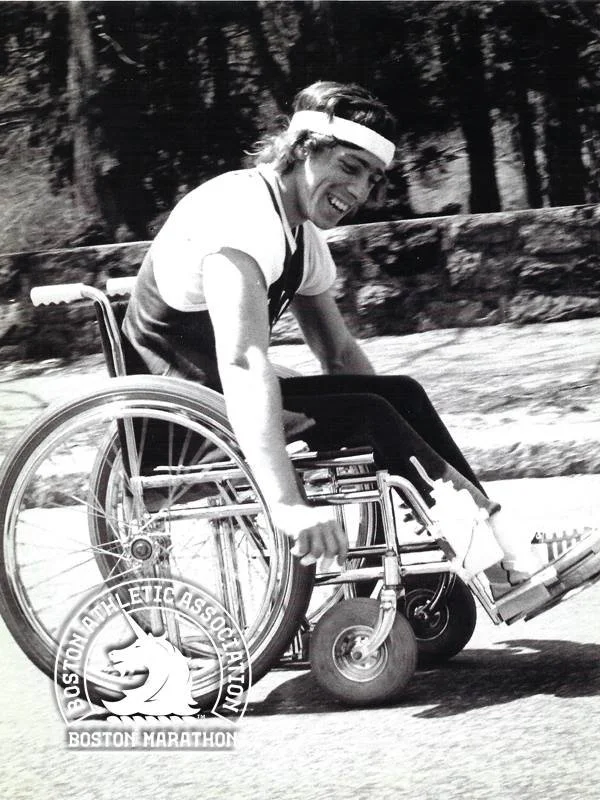
Bob Hall, 1975 Boston Marathon
1970s
Vietnam veteran Eugene Roberts would be one of the many wheelchair division pioneers who raced without a bib or official race recognition. In 1970, Roberts finished unofficially in 7:07:00. In doing so, he laid the groundwork for changing the rules and the arbitrary physical boundaries in place for the marathon.
Later in 1975, Bob Hall, a 24-year-old athlete from Belmont, Massachusetts, would race and be the first wheelchair finisher to successfully lobby for official recognition. He finished in 2:58:00 using a standard, heavy hospital-style wheelchair! His sub-3-hour finish proved to Race Director Will Cloney that wheelchair athletes were elite competitors, leading to the formal establishment of the division. Bob Hall raced again in 1970 and finished in 2:40:10, a record for the time!
1980s
In the 1980s, George Murray won the men’s wheelchair division of the 1985 Boston Marathon with a time of 1:45:34, making him the first to significantly break the 2-hour barrier!
1990s
Innovation and improvement continued to evolve in the 1990s with Swiss legend Heinz Frei (often referred to as Hank in U.S. circles). In 1994, he brought the course record near the 1:20 mark. His time of 1:21:23 was a gigantic progression in performance. Hank had transitioned to aerodynamic, three-wheeled racing chairs, which would inspire future athletes to do the same.
Jean Driscoll, known as the "Queen of Boston," dominated the women’s wheelchair division with eight Boston Marathon titles, including seven consecutive wins from 1990 to 1996. Her 1994 world record of 1:34:22 stood for 17 years, cementing her legacy as one of the sport’s greatest athletes. In addition to her Boston success, Driscoll competed in four Paralympic Games, earning a total of twelve medals across distances from 200 meters to the marathon, and she won gold medals in the Paralympic marathon. Her achievements made her a global icon of endurance sport and later led to her induction into the U.S. Olympic Hall of Fame.
2010s
In the 2010’s, Tatyana McFadden, known as the "Queen of the Road," became the first athlete (disabled or non-disabled) to win the "Grand Slam" of marathons (Boston, Chicago, NYC, and London) in a single year! She would repeat this feat four times. Her race times included 1:35:06 in 2013 and 1:34:06 in 2017. In 2018, her time was longer, 2:04:39, like many athletes, due to the "Great Deluge" of freezing rain, which caused numerous racers to drop out. 2018 was a heroic win for McFadden and wheelchair racers everywhere.
2020’s
The current Men's Course record holder for the wheelchair division is Marcel Hug, who in 2024 finished with the astonishing time of 1:15:33. This performance is considered one of the greatest individual athletic feats in the history of the Boston Marathon. This accomplishment is made even more legendary by the ‘horror crash’ Hug took at mile 17.5 in Newton, when he took a sharp turn, misjudged his speed, and crashed directly into the padded barriers. Following the impact, he righted his chair and rejoined the race. Hug averaged approximately 2 minutes and 53 seconds per mile, maintaining speeds often exceeding 20 mph.
In 2025, Marcel Hug won his eighth Boston Marathon wheelchair title with a time of 1:21:34, coinciding with the 50th anniversary of the division. The race provided a full-circle moment, as Hug met 1975 pioneer Bob Hall and reflected on how his first racing chair, a "Hall Chair," linked the early advocates to today’s champions.
A “Hall chair” refers to one of the early racing wheelchairs designed and built by Bob Hall, a pioneering wheelchair racer and innovator. Hall hand‑crafted lightweight, performance‑oriented racing chairs in the 1970s, significantly lighter and more competitive than the everyday wheelchairs people used before, and these designs helped set the foundation for modern racing chairs used in marathons and other para‑athletic events. Many early champions, including Marcel Hug and Tatyana McFadden, began racing in Hall‑designed chairs early in their careers, demonstrating how his equipment innovations helped shape the sport. (Source)
It’s clear there's been a cultural shift in this running culture. Wheelchair athletes are now celebrated equally with able-bodied runners, and the inclusion in the Boston Marathon happened because courageous individuals actively demanded change.
Proving "impossible" is just a word
If the 20th century was about women proving they could run 26.2 miles, the 21st century at the Boston Marathon has been about dismantling every remaining assumption about physical and intellectual limits.
This adaptive and inclusive revolution began with Bob Hall and has broadened to include divisions for Vision, Intellectual, and Limb Impairments. The formation of these specific divisions was a multi-decade evolution, moving from "unofficial" participation to a highly organized, professionalized structure known today as the Para Athletics Divisions. This division provides elite-level competition and prize money for athletes with impairments.
Over the past 50 years, medical classifications and international Paralympic standards have become more refined, providing more opportunities for people of all abilities to race. The Boston Marathon now has an Adaptive Program for Runners, which “provides support for athletes with visual, physical, or intellectual impairments to participate and take part in the Boston Marathon”.
Vision-impaired (VI) athletes began running the Boston Marathon in the 1970s and 80s, using guides to help them navigate the course. In 2007, the B.A.A. officially established a dedicated Visually Impaired Division with its own qualifying standards and awards. Today, these are classified under international "T" (Track) classifications: T11 (total blindness), T12 (severe impairment), and T13 (moderate impairment).
In 2025, the T11/12 finishers for Men and Women were Wajdi Boukhili, Tunisia (2:25:12) and Joyce Cron, USA (04:09:08).
Boukhili’s 2:25:12 is a pace of roughly 5:32 per mile. For most amateur "open" runners, this would place them in the top 100 out of 30,000 participants.
Cron’s 4:09:08 is a pace of roughly 9:30 per mile. This is exceptionally fast for the grueling, hilly Boston course (especially Heartbreak Hill), where maintaining a steady rhythm is difficult for any runner, let alone one with visual impairments.
What does it mean to race with Visual Impairments?
Terminology and Requirements
T11 — Near-total to total blindness. — Athletes usually wear a blindfold and must run with a guide runner.
T12 — Severe visual impairment (can recognize the shape of a hand).— Athletes have the option to run with a guide runner or use a tether.
T13 — Moderate impairment.— Athletes do not have the option to run with a guide runner, tether, or blindfold. *The Boston Athletic Association (B.A.A.) sometimes allows T13 runners to use a guide for safety.
Both Wajdi Boukhili and Joyce Cron won their races with the help of their guides. Running with a guide is another challenge for runners.
A Guide Runner is a person who provides verbal cues and navigation support to an athlete with a vision impairment on the marathon course.
The Rules for using a guide runner include: the athlete leads, the guide provides direction but never pulls or pushes, and the athlete must cross the finish line before the guide. For elite times, such as Boukhili’s 2:25:12, runners may use two guides, one for each half of the race, to maintain top pace. In short, it’s a team effort: the athlete supplies the power, and the guide handles the navigation.
When using a tether, the runner and guide are connected by a short, flexible handheld strap. They must stay perfectly in sync—when the runner’s left foot hits the ground, the guide’s left foot must hit too.
Verbal coaching has the guide act as the runner’s “eyes,” calling out essential details such as terrain, for example, “Curb in three steps” or “Hill starting now,” and managing crowds with prompts like “Water station on the right” or “Runner passing on the left.”
Adaptations and Inclusion
The Limb Impairment & Mobility Divisions had athletes racing in the 1990s. This division was only made official after the 2020 pandemic hiatus, when the B.A.A. reviewed its competitive categories and expanded the Para Athletics Divisions to include athletes with lower-limb impairments (T61–T64) and upper-limb impairments (T45–T47). This was a major milestone because this change allowed athletes using prosthetics or those with coordination impairments (such as Cerebral Palsy) to compete for specialized prize money and titles for the first time.
Jami Marseilles, who ran the Boston Marathon in 2016, made history as the first female double amputee to complete the race. She crossed the finish line three years after losing her legs to frostbite following a 1988 car accident, mentoring fellow amputees in the process. Running on prosthetic legs in honor of 2013 bombing survivor Celeste Corcoran, she finished the race in 7:46:00. Marseilles brought massive visibility to "blade runners." It is important to note that Jami Marseilles is specifically highlighted as the first female double amputee to finish, but many other athletes have completed the race with prosthetics.
Another historic adaptation to the Boston Marathon Divisions occurred in 2024, when the Boston Marathon became the first World Marathon Major to add a competitive T20 Division for athletes with intellectual impairments. To compete in this division, athletes must have an evidence-based diagnosis of an intellectual disability (manifested before age 18) and a formal international classification. The impact of this rule change was seen as a major step in acknowledging that "adaptive" sports include neurodiversity, not just physical mobility.
This accommodation to human needs and abilities continues to inspire people from different communities to run and participate in the Boston Marathon. What was once thought to be a near-impossible feat of human endurance for professional athletes is now an encouraging platform where every participant defines success differently. With improved medical support, accessibility adaptations, enhanced aid stations, and improved race logistics, the race can celebrate the inclusion of anyone determined to cross that finish line.
Resilience & Healing
As runners prepare for the 130th race on April 20, 2026, carry on the legacy of this nearly uninterrupted event. Through times of war and financial struggle, the Boston Marathon has endured and given people a chance to achieve their goals. The following challenges and tragedies in the United States affected the Boston Marathon, perhaps in ways one might not anticipate.
The first interruption occurred in 1918 while the U.S. was fully engaged in World War I. The nation was mobilizing, and able-bodied men were transported overseas and not left behind to run a marathon. Though the traditional Boston Marathon was suspended, it was transformed into a Military Relay for servicemen preparing for deployment. Instead of the standard 26.2-mile individual race, the race was run as a team relay.
There were 10-person teams, and each participant ran approximately 2.5 miles. The course route was the same, stretching from Hopkinton to Boston. The competition was limited to military teams from U.S. Army units, Navy and Marine Corps teams, and even some allied military participants stationed in the U.S. The winner of this altered race was a team from Camp Devens (now Fort Devens), a major Army training facility about 35 miles northwest of Boston.
This one-time event wasn’t intended to be just a race. It carried a deeper meaning, boosting morale during wartime, demonstrating the physical fitness and readiness of U.S. troops, and fostering a sense of national unity and purpose. In 1919, the Boston Marathon returned to its traditional individual format, marking a return to normalcy after the war. The 1918 Relay shows that even beloved traditions would pause for a national crisis.
A terrifying and memorable date occurred in 2013, referred to as the “Boston Marathon Bombing”.
At 2:45 PM, two homemade bombs spaced 200 yards apart went off. They were placed close to the last 225 yards of the race, in the heart of Boston. These explosions injured 280 people, and 3 people died. Initially, following the blasts was disorder and fear as runners, volunteers, spectators, and first responders scattered. The bombing halted the Boston Marathon. In the context of the race, several races had finished in the previous 3 hours, but many runners were still competing, hoping to finish. Marathon participants were given grace and encouragement. If a racer had completed more than half the course and did not finish due to the bombing, they were given automatic entry into the 2014 race.
Though this horrible tragedy terrified people around the country, Boston grew out of this event as “Boston Strong” and was more determined than ever to ensure a safe and supported 2014 race.
The following year, the marathon was up and running again, and nearly 2,500 runners returned from the 2013 marathon group whose races had been disrupted by the bombing. This recovery of the runners, the city of Boston, and the Boston Marathon shows the pure power of resilience.
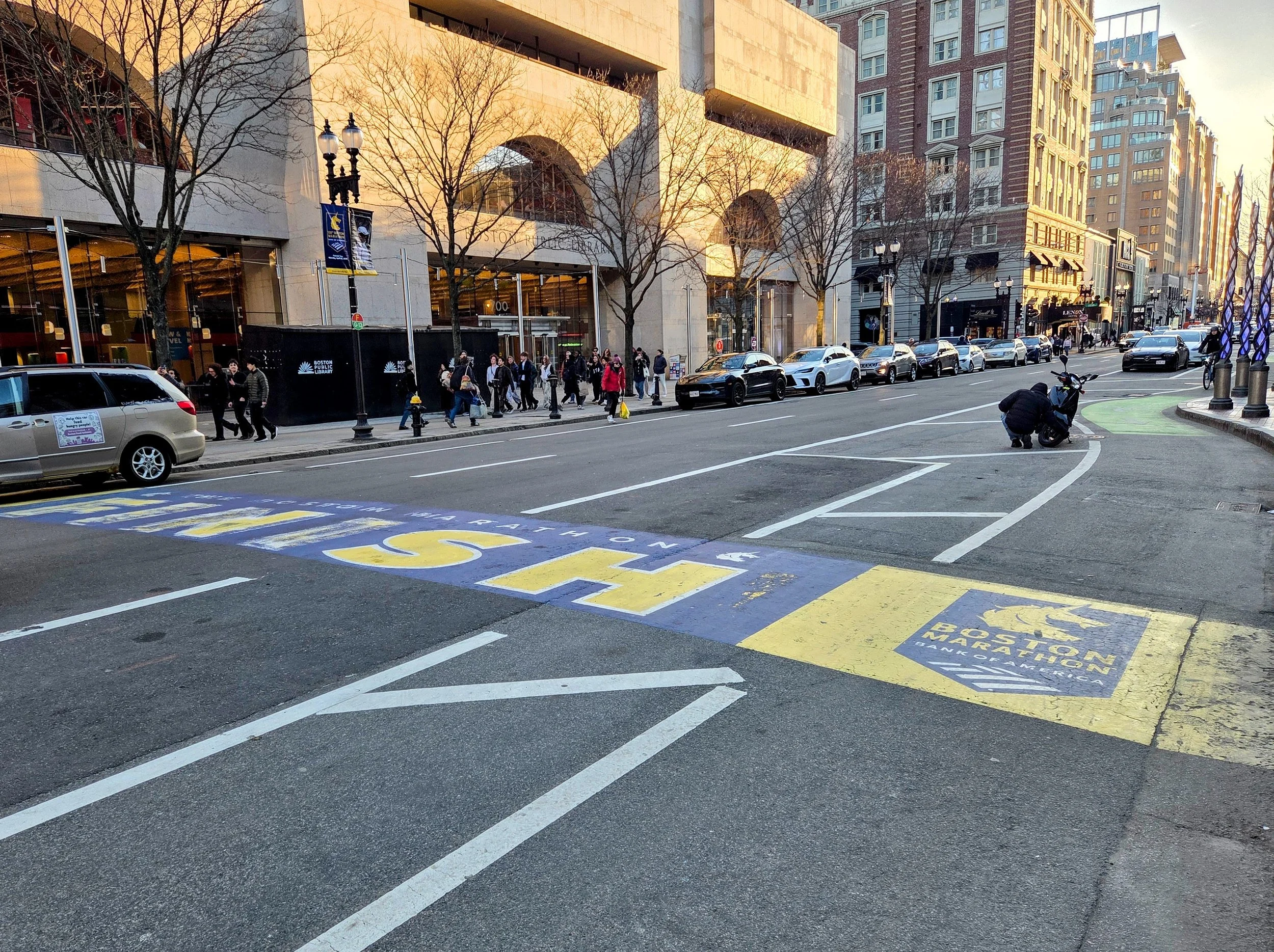
Boston Marathon Line
Due to the global coronavirus pandemic, the Boston Marathon was cancelled. This break in the 124-year tradition was startling. As the world was trying to figure out how to maintain health and safety, the B.A.A. postponed the April race to September. The pandemic continued, and the organizers chose to cancel the race for the year.
To maintain energy and passion for the event, the Marathon officials offered a virtual marathon so racers could compete safely. This “virtual marathon” experience was available for runners who had registered for the 2020 race. The participant had to complete the 26.2‑mile distance on their own between September 7 and 14. A typical Boston Marathon had 30,000 runners, and the virtual event had 16,000 participants from across the United States and around the world. The participant was required to provide proof that they ran the distance in a single continuous effort within a six‑hour period. By submitting proof of their run, they would receive an official Boston Marathon medal, bib, T‑shirt, and program just as they would with the live event. This virtual experience was not the same, but it acted as a lifeline for people everywhere. Many runners raised money for charity and helped generate over $32 million for nonprofit organizations!
The following year, April 2021, was eagerly awaited, and the organizers planned to resume the marathon as normal. However, the persisting COVID‑19 pandemic continued, and the 2021 race was postponed due to health and safety concerns. The 125th edition of the Boston Marathon was pushed to the fall of 2021. This would be the first time the race would be held outside of spring on its traditional Patriots’ Day date in April, aside from the virtual marathon.
On October 11, 2021, the Boston Marathon held its traditional in-person race. The B.A.A. organizers moved the 2021 race from its traditional Patriots' Day date in April to Columbus Day, which is a federal holiday in October (unlike Patriots' Day, a local holiday in Boston). The race was limited to 20,000 runners who had to undergo additional health and safety requirements. The Boston Marathon was held the day after the Chicago Marathon, and multiple wheelchair racers chose to compete in both. The human spirit was stronger than ever.
Boston Strong & Modern Legacy
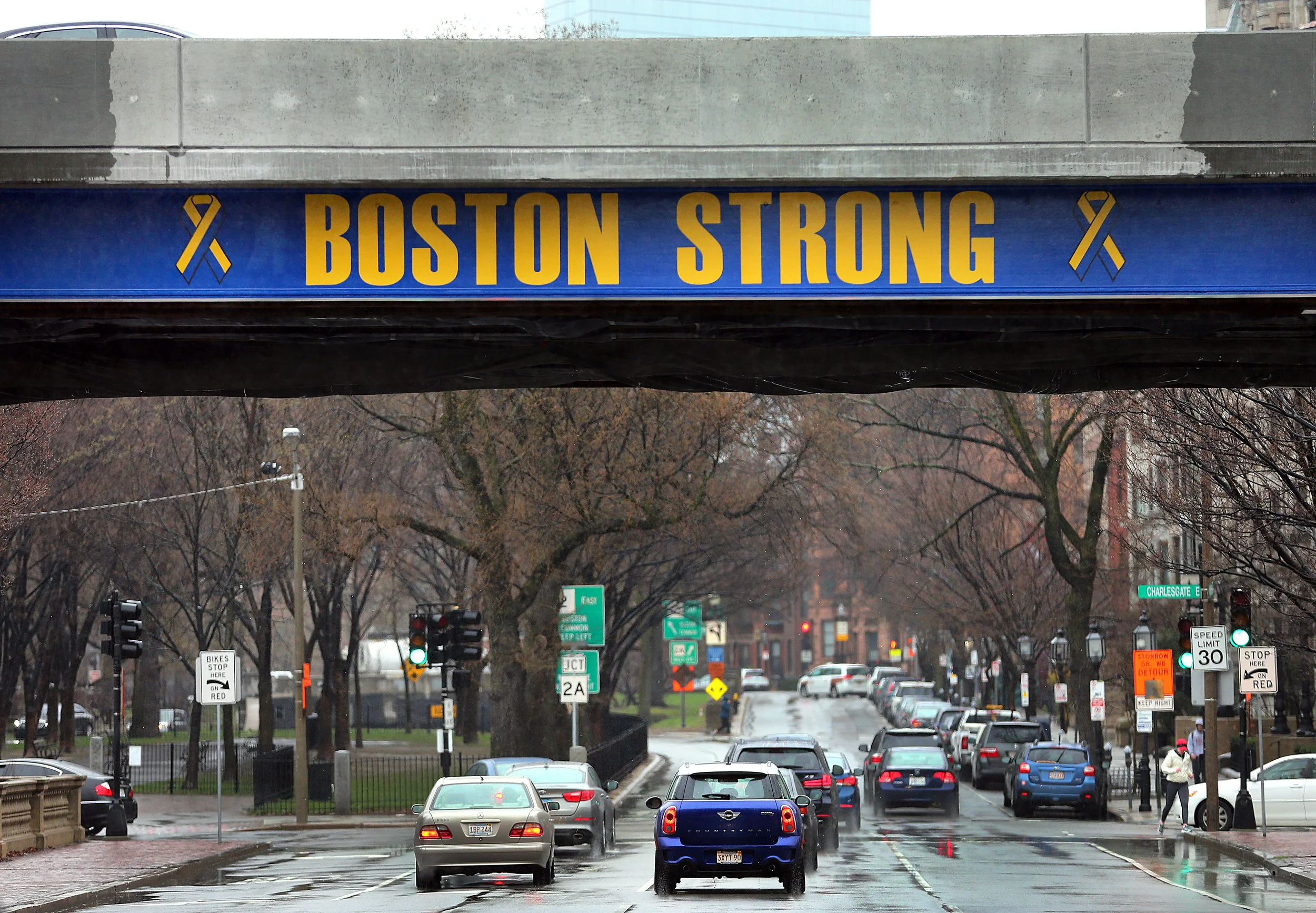
Boston Strong - symbolic slogan after the bombing. Painted above the Boston Marathon course route on Commonwealth Ave, signifying the last mile of the marathon.
Each of these harrowing events that altered this beloved marathon clearly showed that perseverance in the aftermath of tragedy strengthened the community (locally and globally). Today in Boston, you can visit the marathon finish line. It is painted on Boylston Street and is maintained each year before the marathon. This is a place to inspire future athletes as well as remember the lives of those who have crossed it, and even remember the three lives that were taken by the bombing.
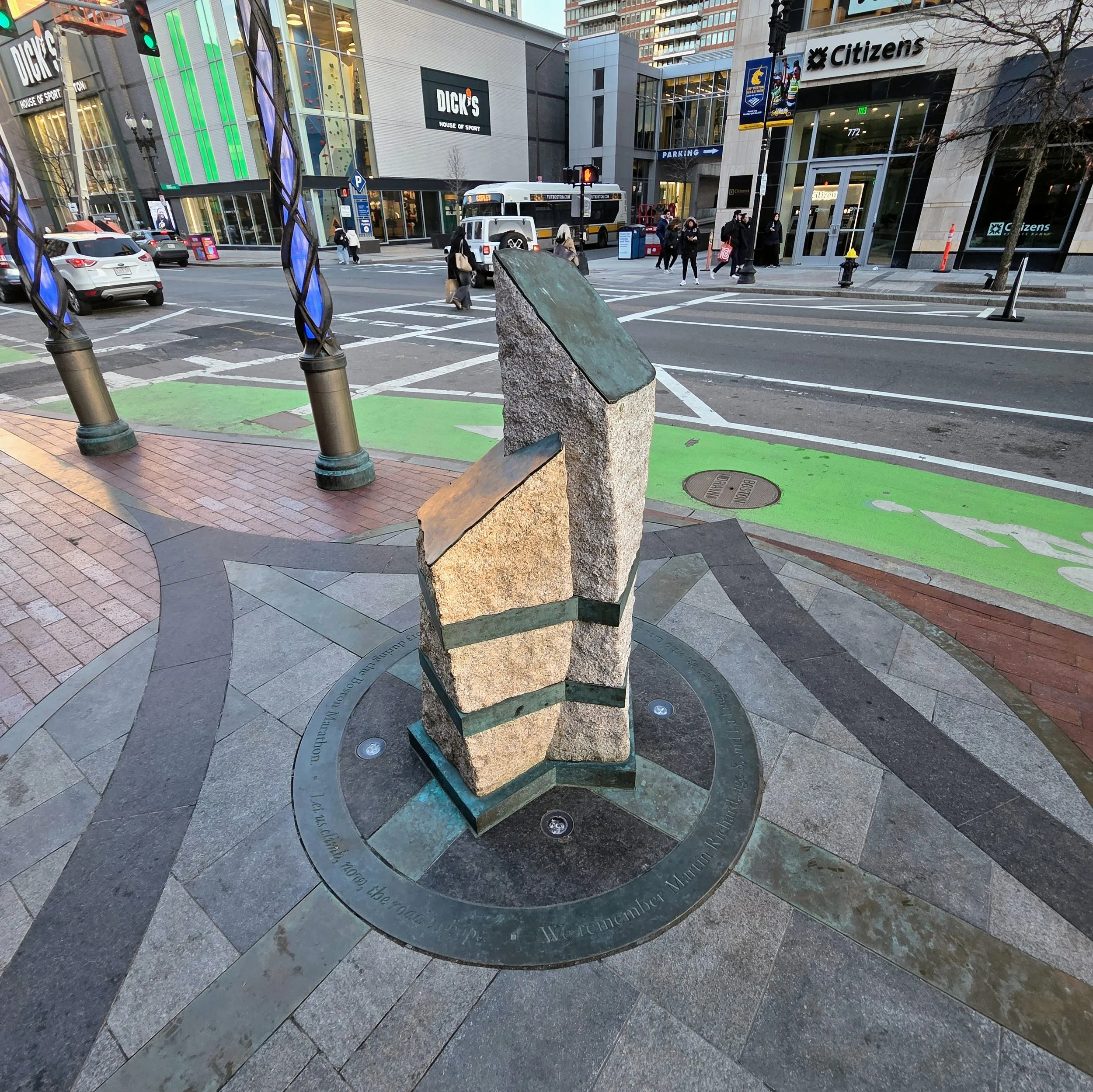
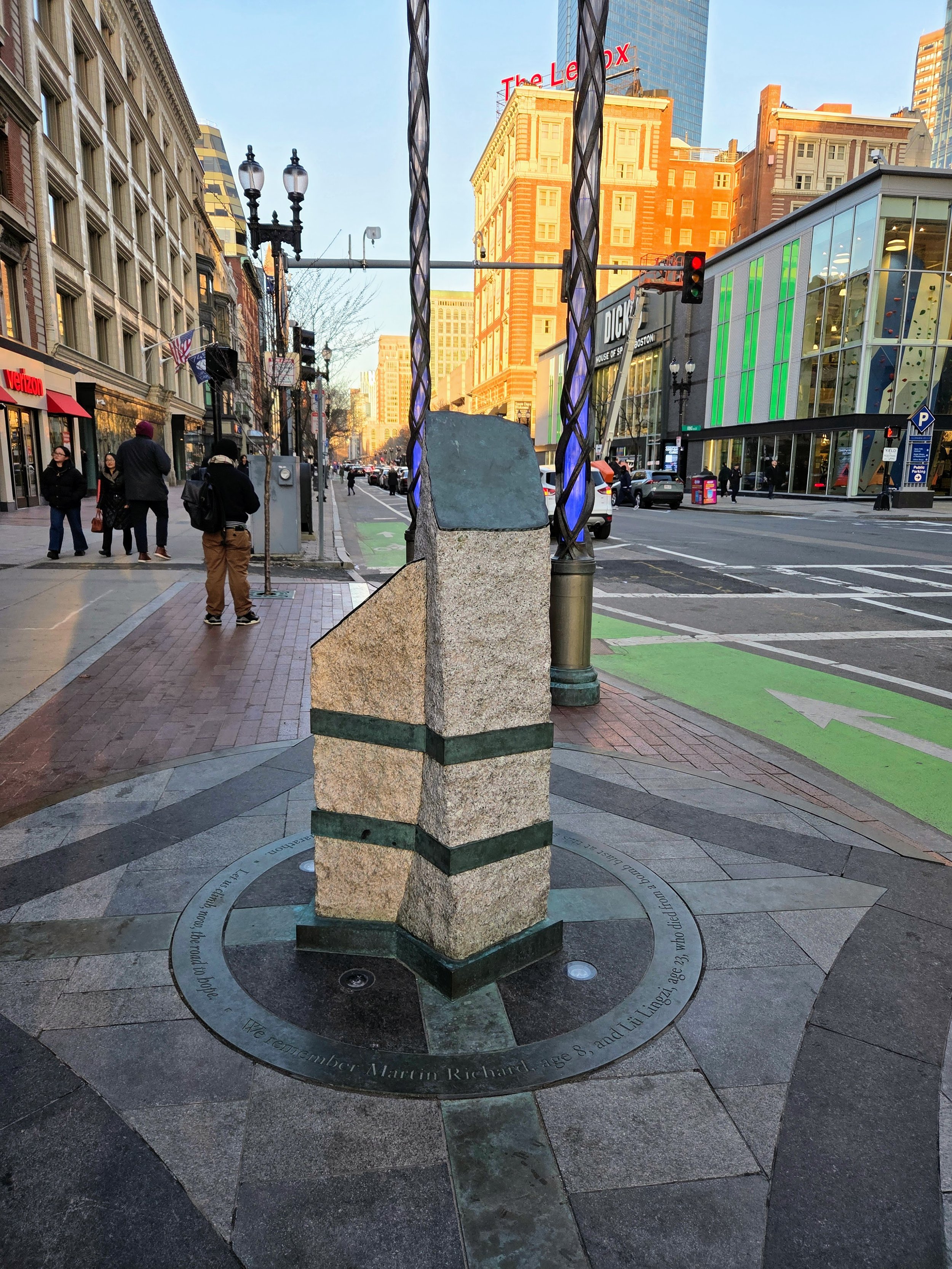
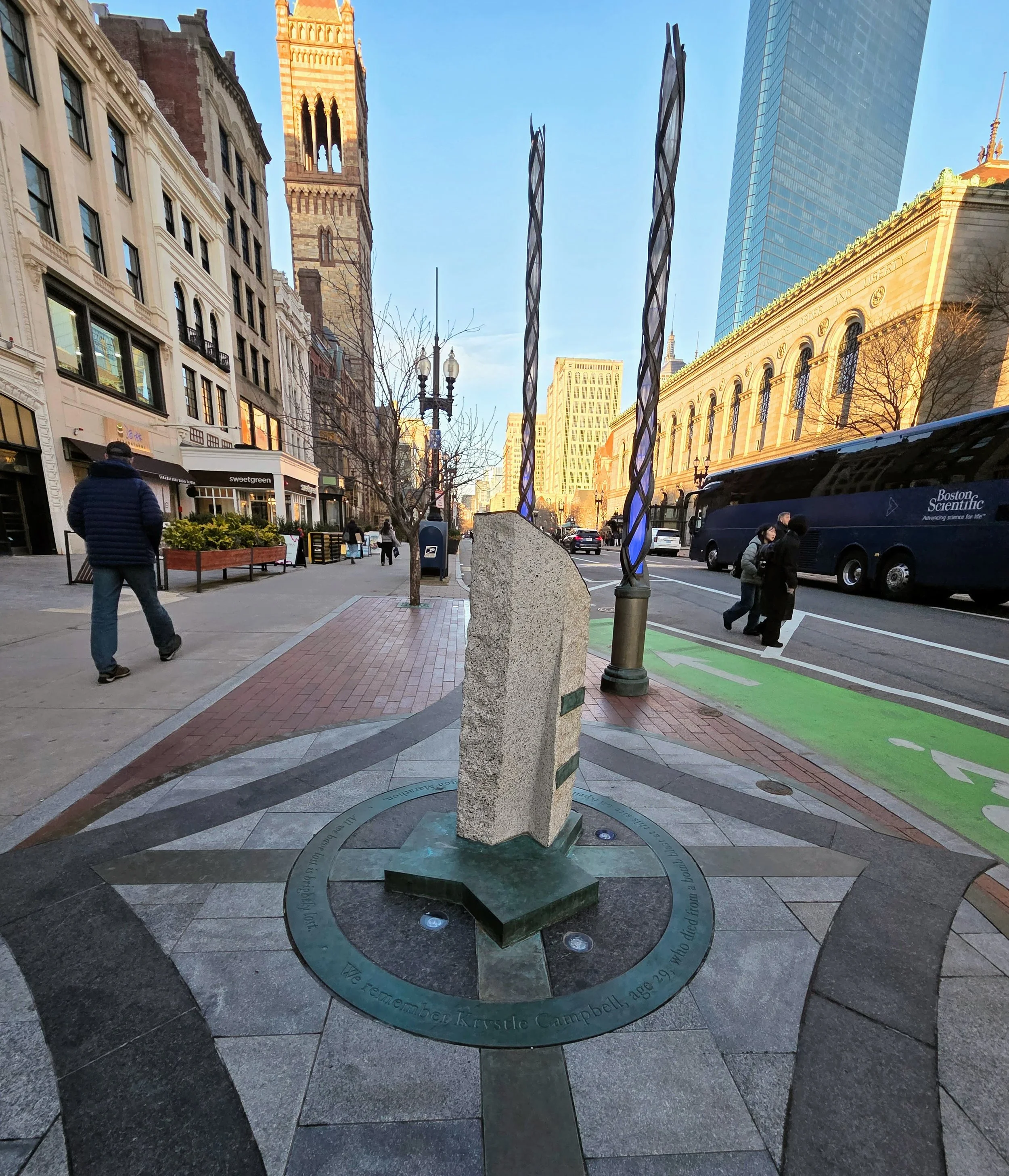
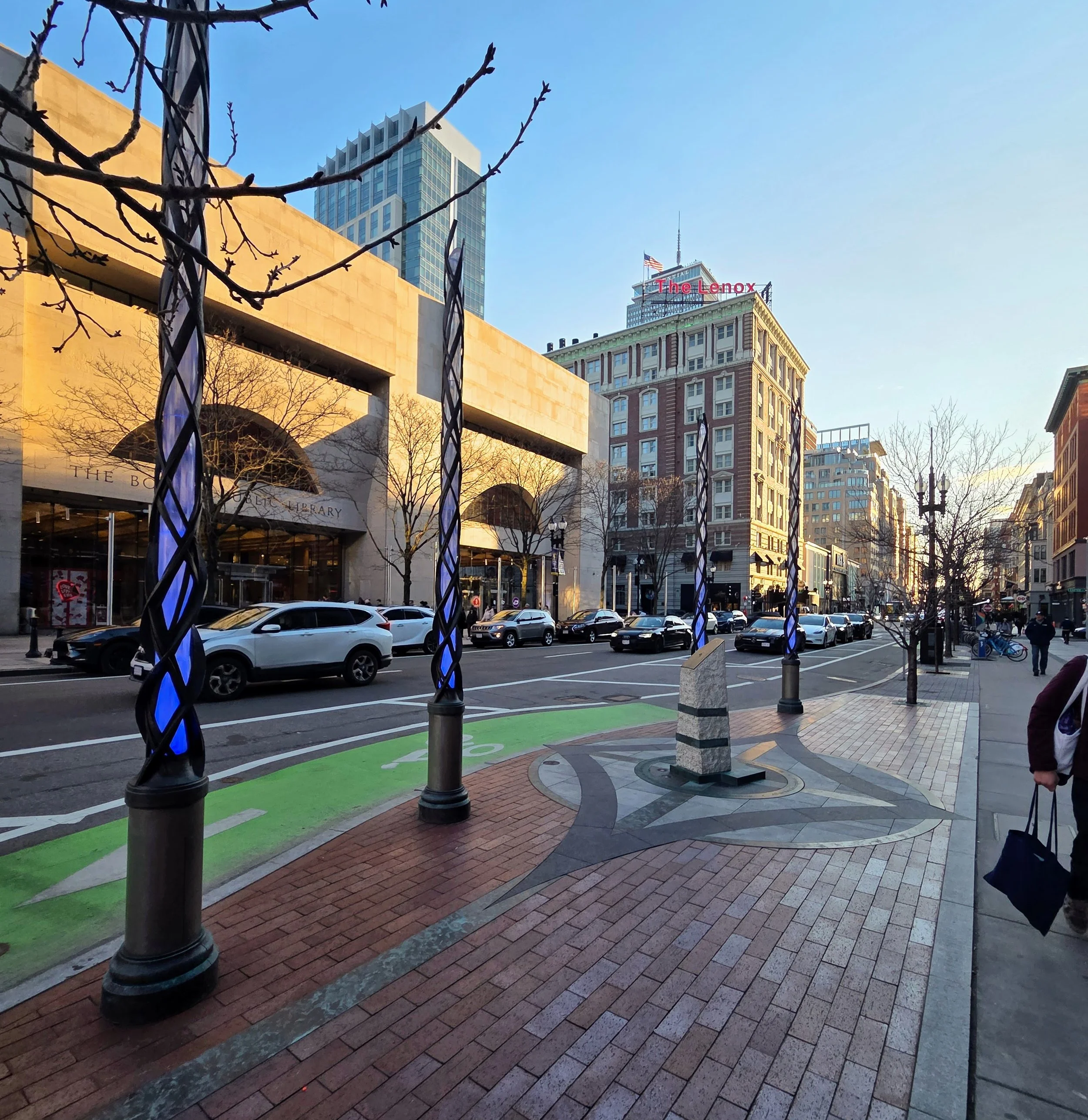
To commemorate the three people who were killed in the Boston Marathon Bombing, there are there are 3 stone pillars along Boylston Street leading to the finish line. There are two marked sites for this memorial, located where the two pressure cooker bombs detonated.
The pillars installed range in height from about 4 to 6 feet. Each pillar is constructed from materials gathered from places in Boston significant to the bombing victims.
Martin Richard (8 years old) - His pillar is from Franklin Park in Dorchester, where he and his family live.
Lingzi Lu (23 years old) - She was a Boston University graduate, and her memorial pillar was donated by the school.
Krystle Campbell (29 years old) - She was a local New Englander, from Medford, a town in greater Boston. Her pillar is from Spectacle Island in Boston Harbor.
Each site has added bronze and glass spires that illuminate the memorial pillars. These memorials are places of healing and remembrance and stand among the spectators of each annual marathon.
Community & Spirit
What sets this race apart from other athletic events? As previously mentioned, there is something special about the proud and long history of this marathon. Athletes and spectators alike enjoy and look forward to this annual race. In the week of the marathon, the city buzzes with new energy that carries over onto race day. Visitors from around the country and around the world arrive in Boston to race or cheer.
An estimated 1 million people line the 26.2-mile course to support and encourage the racers. They are key in helping runners feel seen and supported while they push their bodies to the limit.
The Boston Marathon course is long and challenging, and amid the spectators' cheers, there are traditions that runners eagerly anticipate. These traditions motivate and boost the morale of tired racers.
Racers in the marathon can expect to be deafened by the Scream Tunnel near Wellesley around mile marker 13. Halfway through the course, students from Wellesley College gather near the halfway point in the race to scream for the runners while holding their famous “Kiss Me” signs. This is an age-old tradition that dates back to 1897, when female students gathered to cheer for their favorite young and handsome runners. Today, the cheers and screams are so loud that runners can hear them a mile away. This anticipated tradition is fun for locals and students alike and encouraging for runners as they enter the final half of the race.
Another benefit of spectators is their support and encouragement at one of the most feared sections of the Boston Marathon course: “Heartbreak Hill”. Located in Newton, between miles 20 and 21, this is the third hill of the race. The hill is a gradual incline of half a mile and is not especially difficult on its own, but because it is so late in the course, runners are low on energy and tired as they push to get over this hill to the finish line. It is heartbreaking to see racers struggle to climb this hill, and some even have to walk it. Many spectators plant themselves in this section because they know that runners will need the boost of energy and encouragement as they climb Heartbreak Hill.
The runners are the focus of the marathon, but the spectators are a key element that adds energy to the atmosphere, creating a 26.2-mile-long support system.
2025 Marathon Course Route
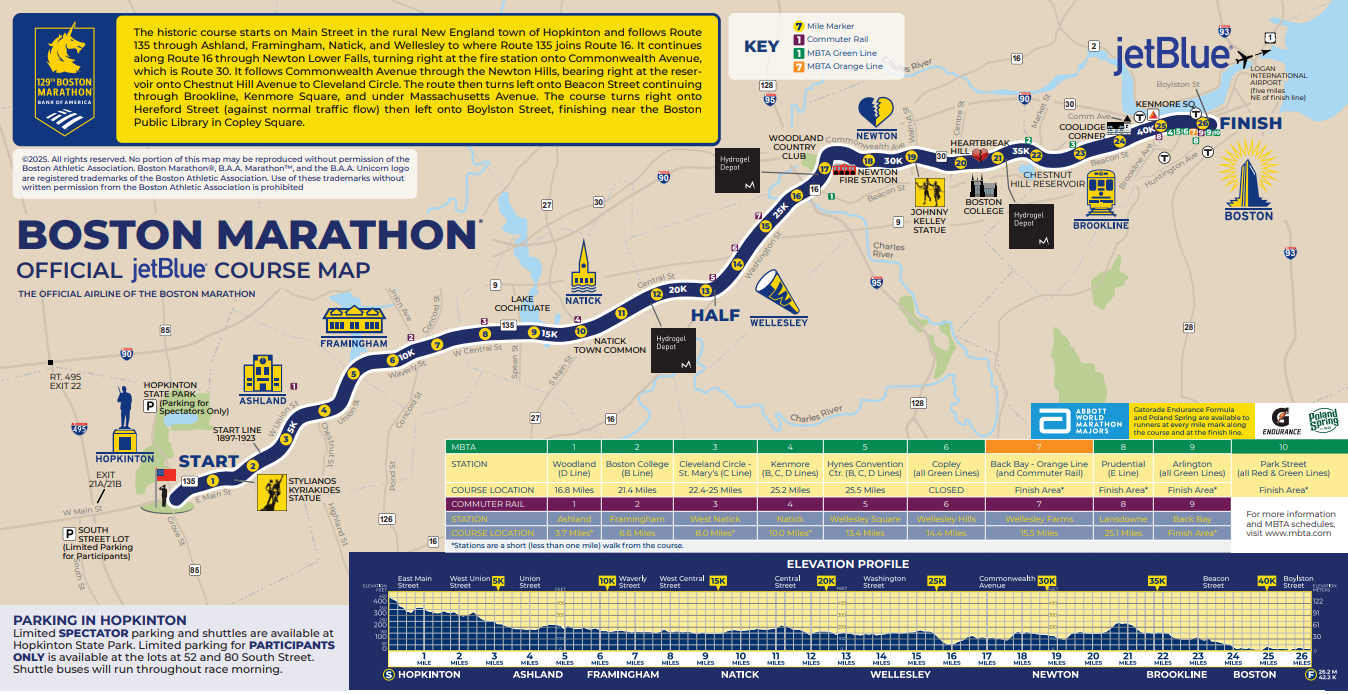
Though the original course was only 24.5 miles, the current Olympic distance of 26.2 miles, established in 1924, has continued to challenge and thrill runners over the past century. The Boston Marathon Course is famous for its rural start that ends in the heart of historic Boston. The course is primarily downhill, though it has significant obstacles that require runners to use strategy.
The course is varied as runners progress through each town.
Beginning in Hopkinton, the first 4 miles through Ashland & Framingham feature some of the fastest mile times, as racers experience a ~130-foot drop in elevation that propels them forward, sometimes tempting them to expend more energy earlier than desired.
Cruising through Natick, runners find their pace and sustainable rhythm in this flatter stretch.
At the halfway mark, the Wellesley "Scream Tunnel" celebrated runners as they begin the grueling second half.
Once entering Newton, the racers brace when they see the Newton Fire Station at mile 17.5. This marks the beginning of the four-hill gauntlet. Newton is the most feared section due to the four "Newton Hills." The most iconic hill is at 20–21 miles, “Heartbreak Hill”. It’s an 88-foot ascent that breaks many runners' spirits just as they hit "the wall."
After surviving the Newton hills, it is mostly downhill or flat until the finish line as racers enter the final miles through Brookline and enter Boston.
The landmark that gives runners hope is the iconic Citgo sign in Kenmore Square. This signals they have exactly 1 mile to go before the world-famous 600-meter dash on Boylston Street to the finish line in iconic Copley Square.
The Boston Marathon's route is a map of New England identity and pride enjoyed by all who race or spectate.
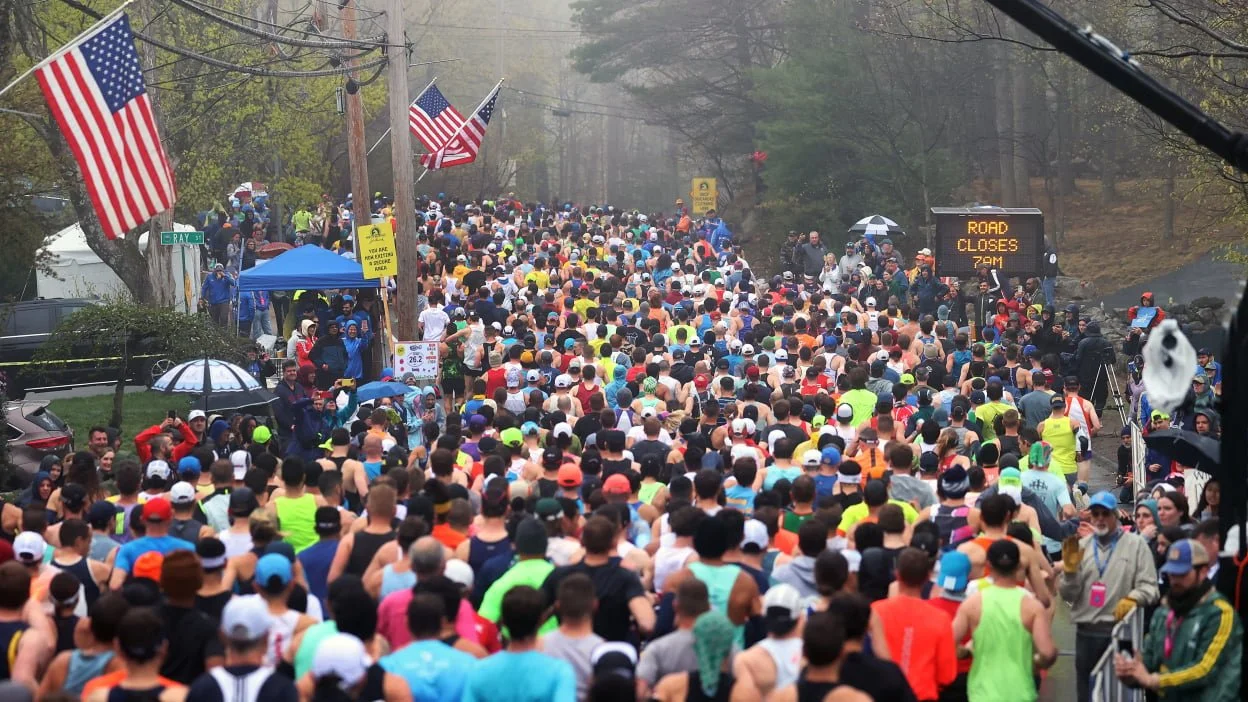
Racers starting in mass numbers.
While runners enjoy the city, visit the runners' expo, and rest before Marathon Monday, nearly 10,000 volunteers are preparing the course and getting ready for the big day to help this event run (pun intended) smoothly.
Essentially, volunteers are trained in emergency protocols, learn their responsibilities, including how to hand off a water cup at 15 mph. They receive official credentials to volunteer and get an official volunteer jacket. Course volunteers spend Saturday and Sunday prepping the 26.2-mile course to assemble hydration stations, miles of barricades, and the ‘Athlete Village’ in Hopkinton, where the 30,000 racers will wait to start. Medical professionals spend the 2 days prior to stocking 26 medical tents along the course, ready for anything. They have specific IV bags for dehydration to specialized "ice baths" for heat stroke. Gear Check Volunteers organize the 30,000 bags dropped off by each runner, which contain the items they need after crossing the finish line.
Who are these people who do so much for this event?
An estimated 45% of volunteers (~4,500 people) are locals from the eight cities and towns along the course. There are families who have volunteered for multiple generations and might have managed the same hydration station since the 1980s. The locals are the human engine that shapes the Boston Marathon's character and values. There is also local civic pride for local police, fire departments, and rotary clubs, who view Marathon Monday as a major service day in the community.
A group of highly trained medical professionals, doctors, registered nurses, physical therapists, and EMTs from Boston’s world-class hospitals (Mass General, Brigham and Women’s, etc.) make up about 18% of volunteers (~1,800 people) to make up the “Medical Army.” Their volunteer time and expertise are invaluable. For many sports medicine professionals, the draw of this event is at the Boston Marathon Finish Line, where the medical tent is the epicenter of triage and acute care.
The estimated 15% of volunteers (~1,500 people) known as "Giving Back" Runners are people who did not qualify and just missed the “cut-off” time,veteran Boston Marathon race veterans who have run the race 10+ times, and choose to give back, or injured runners who want to support the community.
Students and Youth in the area make up about 12% of volunteers (~1,200 people) and are known as the ‘heavy lifters’. With over 50 colleges in the Greater Boston area, students are everywhere. Most commonly, students from BU, BC, and Northeastern handle the “muscle” roles: gear bag logistics, setting up heavy barricades, Expo setup, and crowd control.
Finally, the "Lifers" (The 30+ Year Club) volunteers often hold leadership roles. They serve as Station Captains and mentors, ensuring 129 years of tradition stay intact. This group makes up nearly 10% of the volunteers (~1,000 people) who have deep knowledge of the event's traditions and functions, from knowing exactly where the wind hits hardest at Mile 17 to how to calm a cramping runner at the finish. The B.A.A. officially honors volunteers who have served for 30 or more consecutive years.
The Boston Marathon awakens every April full of hope, ambition, and tradition. This marathon carries a gravity that few sporting events can match, rooted in the history of Patriots’ Day and the spirit of the American Revolution. It turns into a demonstration of community and pride that goes beyond mile times.
What makes this event extraordinary is the synthesis of its parts. It is the Scream Tunnel at Wellesley and the roar of the crowds that push runners up the brutal incline of Heartbreak Hill. It is the “Medical Army” and the “Lifers” who form the quiet, indispensable backbone of the course. From the rural start in Hopkinton to the urban triumph on Boylston Street, the route is a map of New England identity, connecting small-town charm to the global stage of a world-class city.
Since 1897, the race has survived world wars, pandemics, and the 2013 tragedy, emerging each time with a deeper sense of resilience. The arc of the marathon is a narrative of progress evolving from a men-only starting line to a globally inclusive celebration in 2026. While the world changes, the constants remain: the raw courage of the runners, the boundless generosity of the volunteers, and an unwavering belief in human potential.
The Boston Marathon is an electric moment waiting for you. Whether you are chasing a personal best, handing out water to a stranger, or cheering until your voice cracks, you are stepping into a living history.
No matter your role, the experience is guaranteed to be moving and thrilling. Because at its core, the Boston Marathon’s greatest accomplishment isn’t a time or a medal. It’s 129 years of proving that together, we’re stronger.
